Toward a theory of
ethical embeddings
Three problems that look separate — who a recommender makes visible, what a language model associates with whom, and what a sanitized text still means — are the same problem in different clothes. Each is a question about what a representation encodes, and who pays for it.
Exposure is a resource, and it is allocated
Recommendation algorithms decide visibility. MinWalk optimizes for accuracy and equitable exposure together, integrating exposure-parity constraints with dynamic network modelling rather than treating fairness as a post-hoc correction.
- Mitigates homophily and popularity bias, raising minority visibility over time.
- Constrained optimization with stochastic sampling, so it scales to large graphs.
- On social and citation graphs, visibility gains for under-represented users at minimal precision cost.
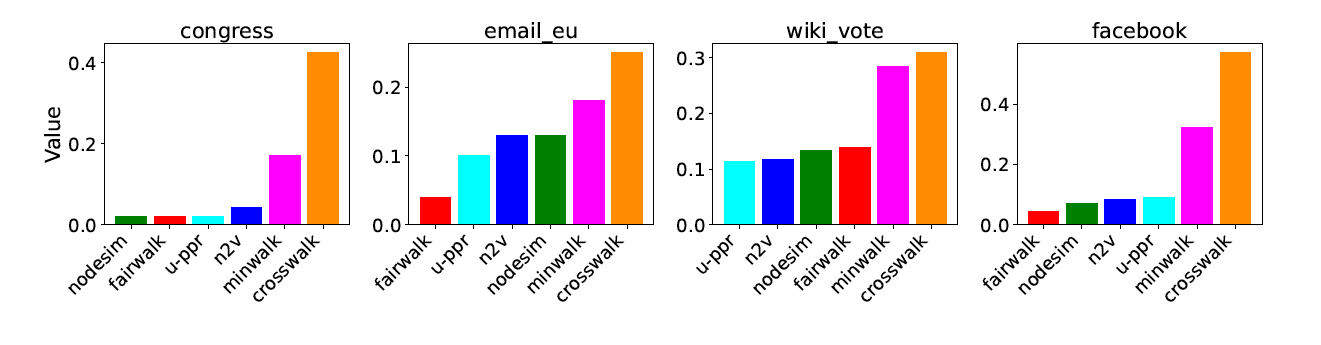
MinWalk vs baselines across four network datasets. Click to enlarge.
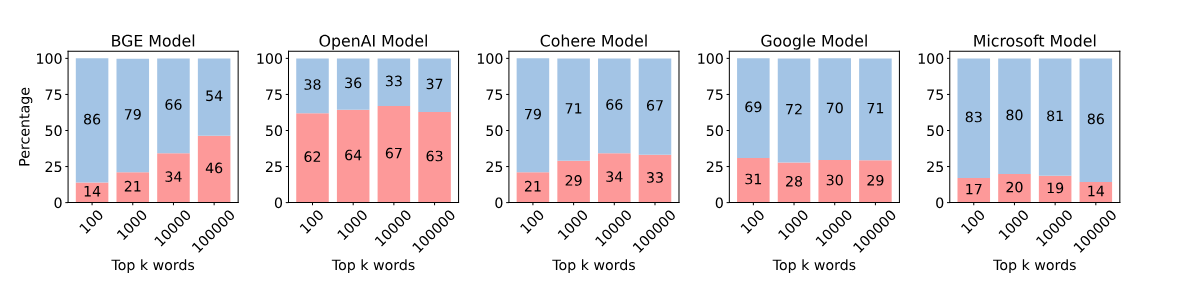
Gender-linked association across five providers, by top-k words. Click to enlarge.
A bias you cannot measure is one you cannot fix
I quantify demographic bias in embeddings from major providers using frequency-weighted Fightin' Words, SC-WEAT, clustering, and divergence tests. The output is not an opinion about a model. It is a number, with a method behind it.
- Interpretable scores expose gender and race associations that survive into downstream tasks, including product recommendation.
- Multi-method audit pipelines (Marked Words, SVM, Jensen–Shannon divergence) that point at actionable mitigations.
- Audited across OpenAI, Google, Microsoft, Cohere, and BGE.
Protect the person, keep the meaning
I work on differentially private text by perturbing the embedding space rather than token probabilities. That preserves coherence while reducing memorization and leakage, which is the trade every deployment actually faces.
- CluSanT — sanitization under Metric Local Differential Privacy, with clustering to hold semantics at a given budget.
- Lower identifiable memorization while retaining high human-rated quality.
- Applications in healthcare narratives, legal anonymization, and educational feedback.
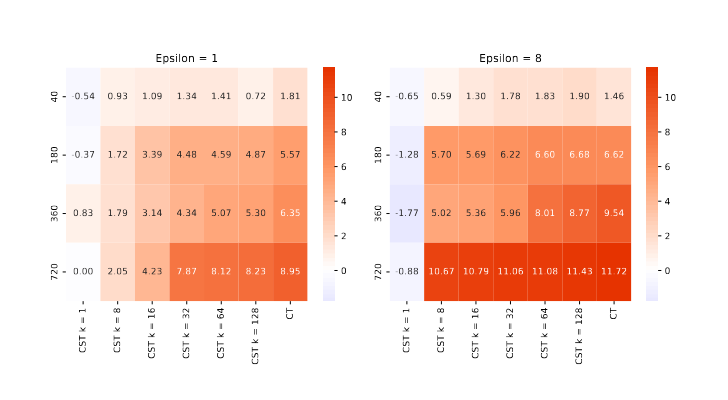
CluSanT vs CusText — semantic similarity gain at ε = 1 and ε = 8. Click to enlarge.
Where this goes
The three threads converge. Each is a claim about what a representation encodes; the goal is one framework that treats them as such.
-
Dynamic fairness
Treat fairness as a temporal property of evolving networks, not a snapshot. Sustain minority visibility at scale, over time.
-
Systemic bias
Move past local prompt patches toward structural rebalancing of embedding spaces themselves.
-
Privacy as transformation
Coherence-preserving, embedding-level privacy integrated directly into the generation loop.
-
Ethical embeddings
A unified mathematical framework connecting visibility, stereotype, and attribute leakage as one object.
The toolkit
Cross-domain and reproducible, spanning NLP and recommender systems, and built to hold up in compliance contexts such as the EU AI Act and the NIST AI Risk Management Framework.
Read the full statement
The complete research statement goes deeper on methods, results, and the five-year programme.