Postdoctoral Research Fellow · University of British Columbia · Vancouver, BC
Making AI systems
accountable to the
people they overlook
I work on responsible AI across three fronts: fairness in recommender systems, bias in large language models, and privacy in NLP. My PhD built the methods. My postdoc applies them where the stakes are highest, in global health.

Recommenders decide who gets seen
Link recommendation shapes who finds whom in a social network. Left alone, it compounds advantage: popular nodes get recommended, become more popular, and get recommended again. Structural minorities disappear into the tail.
- MinWalk raises the visibility of structural minorities while holding utility loss to a minimum.
- Reduces popularity bias without discarding the signal that makes recommendation useful.
- Best Paper, MEDES 2024.
MinWalk — structural minority visibility in link recommendation. Highlighted nodes are minorities surfaced by the walk.
SC-WEAT — gender and race association in embedding space, measured across models.
Language models carry the bias of what they read
Bias in an LLM is not a rumour to be argued about. It is a quantity that can be measured, in embedding geometry and in what the model actually recommends to people. I measure both.
- Gender and race association in modern embeddings, via SC-WEAT and clustering.
- Bias in consumer product recommendations made by LLMs, where it reaches users directly.
- Published at I-SPAN 2025 and AINA 2025.
Text can be private and still mean something
Differential privacy protects people by adding noise. Add it carelessly and the text stops saying anything. The real problem is not privacy or utility, it is the exchange rate between them.
- CluSanT — text sanitization under Metric Local Differential Privacy.
- Clustering plus embeddings hold semantic coherence at a given privacy budget.
- Published at NAACL 2025.
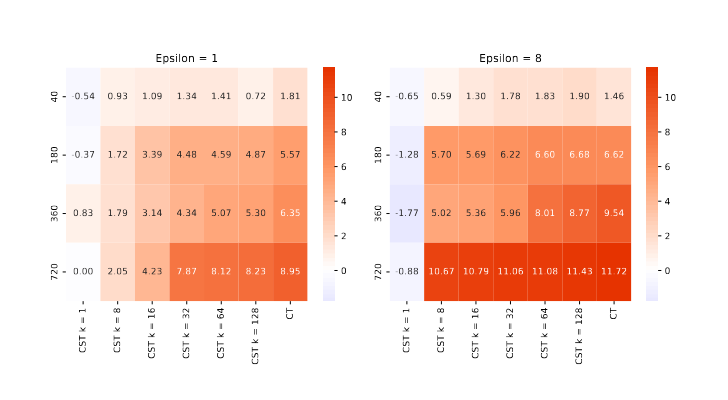
CluSanT vs CusText — semantic similarity gain at ε = 1 and ε = 8. Warmer means more meaning retained at the same privacy budget.
WelTel — two-way SMS between patients and providers, Rwanda and Canada.
The same questions, where the stakes are real
At UBC I work with the Digital Global Health & AI Group on real patient–provider messaging. Bias and privacy stop being abstractions when the data is a person texting a nurse in Kinyarwanda.
- Multilabel topic classification across 19 topics in two clinical contexts, Rwanda and Canada.
- Benchmarked six machine translation systems on real Kinyarwanda clinical dialogue. None is safe unsupervised.
- Bounded claims by design: human-in-the-loop support, never autonomous triage.
Research that has to run
Methods that never leave a paper are hard to trust. These are the systems where the ideas meet users, latency, and consequences.
ConVisScope
A research workbench turning WelTel's two-way SMS stream into population-level intelligence for Rwanda's digital health ecosystem. Cohort filtering, label review and correction, and reproducible export, generating the validated correction stream that trains the next classifier.
NoSpin-EBM
Evidence-based medicine search for clinicians, built around fail-closed provenance: a field renders only when it is anchored to a retrieved record. GRADE-rated evidence cards with verified DOIs, and a Skeptic's Corner that flags bias in the underlying evidence.
PageLink
An auditable replacement for the hospital pager: paging and acknowledgement, on-call scheduling, in-app consult chat and structured clinical coding, designed under Canadian privacy constraints. Built as the artifact that scopes a production MVP.
Training the people who build the next systems
I have designed and taught a core graduate course across three offerings, and supported undergraduate cohorts of up to 180.
-
Postdoctoral Research Fellow May 2026 – PresentDigital Global Health & AI Group, University of British Columbia
AI and NLP research on patient–provider mobile-health data. Topic classification and clinical-language models supporting real digital health programmes, plus AI implementation strategy across the group's mHealth platforms.
-
Instructor — Data Models & Algorithms (CSC 501) Spring 2025 – Spring 2026University of Victoria
Designed and taught this core graduate course across three offerings (≈50 students each), emphasizing active learning and algorithmic problem-solving.
-
Lead Teaching Assistant — Data Mining (SENG 474) Spring – Fall 2024University of Victoria
Coordinated teaching support across three terms, class sizes 50 to 180. Labs in classification, clustering, and pattern mining.
-
Researcher Nov 2022 – Nov 2023Cologne Center for eHumanities, University of Cologne
Workflows for large-scale text and metadata analysis in digital humanities. Advanced Project RACIR through tooling and cross-disciplinary research.
-
Research Fellow Oct 2022 – Mar 2023Electronic Textual Cultures Lab, University of Victoria
Visualizations and computational tools for digital scholarship. Directed the HSS Commons initiative, shaping platform design and implementation.
Publications & manuscripts
Under review
-
Selective Overconfidence: How Large Language Models Underserve Social Welfare Law Across Jurisdictions
AIES 2026 · AAAI/ACM Conference on AI, Ethics, and Society
Under review -
People, Processes, Platforms: A Coding Framework and Comparative Benchmark for Global AI Governance
AIES 2026 · AAAI/ACM Conference on AI, Ethics, and Society
Under review Interactive benchmark →
In preparation
-
Multilabel Topic Classification of Patient Messages Across Two Clinical Contexts
Targeted at npj Digital Medicine
2026 -
Evaluating Off-the-Shelf Machine Translation for Kinyarwanda-to-English Clinical Dialogue
Targeted at The Lancet Digital Health
2026
Peer-reviewed
-
CluSanT: Differentially Private and Semantically Coherent Text Sanitization
NAACL 2025
2025 ACL Anthology → -
Gender and Race Bias in Consumer Product Recommendations by Large Language Models
AINA 2025 · Advanced Information Networking and Applications
2025 Paper → -
Word Embedding Bias in Large Language Models
I-SPAN 2025 · Pervasive Systems, Algorithms, and Networks
2025 Springer → -
Enhancing Structural Minority Visibility in Link Recommendations
MEDES 2024 · Management of Digital EcoSystems · Best Paper Award
2024 Paper → -
Community Structure and Coherence in Digital Humanities Works
IISA 2023 · Information, Intelligence, Systems & Applications · Best Paper Award
2023 IEEE →
Let's talk
Open to collaborations, research partnerships, and teaching. If your work touches fairness, bias, privacy, or health data, I would like to hear about it.